
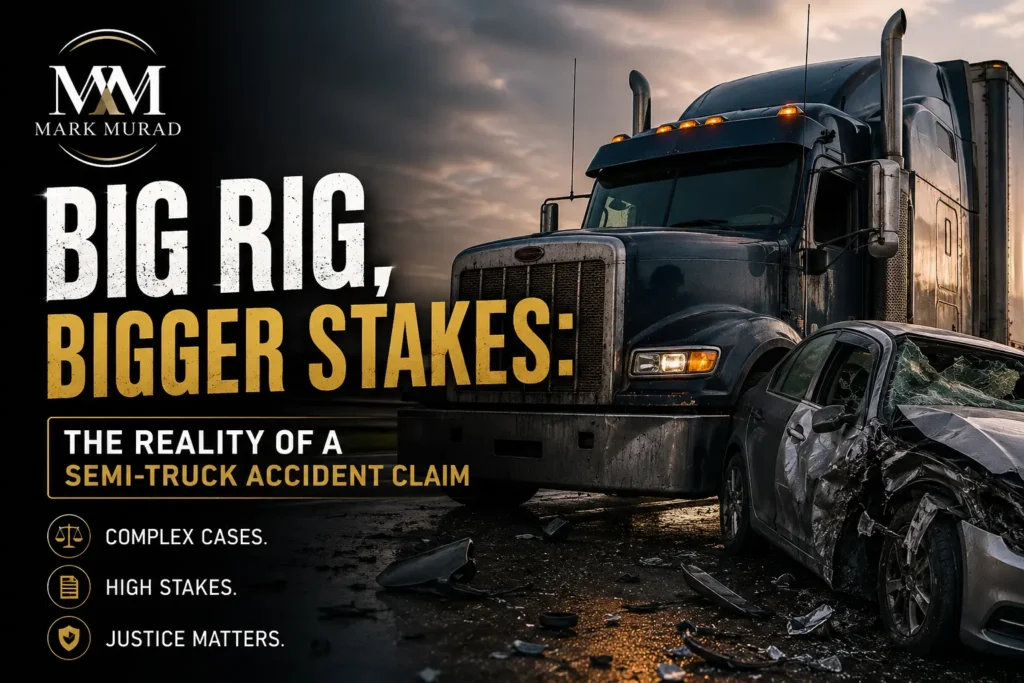
Eighty thousand pounds doesn’t stop like a sedan does. Most people don’t really understand that until it’s their own car crumpled on the shoulder. A loaded semi brakes slower, turns wider, and does damage a regular fender-bender just can’t touch. So when one of these rigs is involved in a wreck, the whole claims process changes with it — the evidence looks different, the list of possible defendants gets longer, and the math on what recovery actually costs gets a lot more complicated. That’s the reason a semi truck accident lawyer can’t treat these cases like a routine car accident case.
Why Semi Wrecks Don’t Look Like Other Crashes
A semi’s blind spots run along both sides of the trailer and stretch out behind it for a long way — long enough to hide an entire car without the driver ever knowing it’s there. Because these trucks are so long, they have to swing wide on turns, and that sometimes means drifting into a lane a driver next to them never saw coming. Then there’s jackknifing, where the trailer swings out of line with the cab — usually on wet pavement or during hard braking — and when it happens, it tends to pull several vehicles into the wreck at once. Underride crashes may be the worst of all: a car slides in underneath the trailer, and the injuries that result are often much worse than the speed of the crash would suggest. Every one of these plays out differently than a typical two-car collision, and each leaves its own trail of evidence behind.
What Gets Left Behind
Trucks like these generate paperwork constantly. Driver logs show how many hours were spent behind the wheel. Maintenance records reveal what got inspected — and what got skipped. Weight tickets show whether the trailer was loaded within legal limits. Piecing all of it together and checking it against federal trucking regulations isn’t something most people can manage on their own, especially while they’re still recovering in a hospital bed.
Figuring Out Who’s Actually at Fault
It’s rarely just the driver. Depending on what caused the crash, liability can extend to the trucking company, the company that loaded the cargo, whoever owns the trailer, even the manufacturer of a faulty part. A frayed brake line might trace back to a maintenance shop. A trailer packed too heavy might trace back to whoever loaded it. Untangling that takes time, and it takes someone who won’t stop at the first convenient explanation.
The Real Cost of These Injuries
A semi-truck collision often means multiple surgeries, months of physical therapy, and in some cases, a career someone can no longer return to. Once you tally the medical bills, the lost wages, and everything else it touches, the total usually ends up higher than anyone expected walking in. The insurance companies covering these trucks know this too — which is exactly why their first offer tends to come in low, often before the full extent of the injuries is even clear.
How the Law Offices of Mark Murad Handle These Cases
The Law Offices of Mark Murad take on commercial vehicle cases because they require a different kind of digging. That means pulling driver logs before they get erased, bringing in accident reconstruction experts when the cause isn’t clear-cut, and refusing to accept a settlement that doesn’t reflect what a client has actually lost.
What to Do in the Immediate Aftermath
Get checked out by a doctor right away, even if nothing feels seriously wrong at first — some injuries take time to show up. Take photos while the scene is still fresh: the vehicles, the road conditions, any damage you can see. Avoid giving a recorded statement to an insurance company until you’ve talked to someone on your side. Reaching out to a semi truck accident lawyer early can keep you from making a decision you can’t take back later.
Bottom Line
A semi-truck accident isn’t just a bigger car crash. It’s its own category — more parties involved, more regulations in play, and more at stake for the people affected. The kind of experienced guidance the Law Offices of Mark Murad brings to these cases often ends up being the difference between a fair settlement and a rushed one.